LMS vs. content libraries: Why your business needs both (and how to pitch it to your boss)
LMS vs content libraries is not an either-or decision. This guide shows L&D leaders how an LMS provides the engine that turns off-the-shelf content into measurable business results — with learning tied directly to business outcomes.

.png)
At Thrive, we talk to HR and L&D leaders every day who find themselves in the same frustrating spot: trying to convince leadership that a massive library of content isn’t a ‘complete’ training strategy.
Executives often ask, and quite rightly, “Why do we need an LMS when we already pay for thousands of courses on (insert content provider of choice)?”
It’s a fair question, but it misses a critical reality: Content is just the fuel. Without an LMS as the engine, your people are left wandering through a library with no map, no direction, and no connection to your actual business goals.
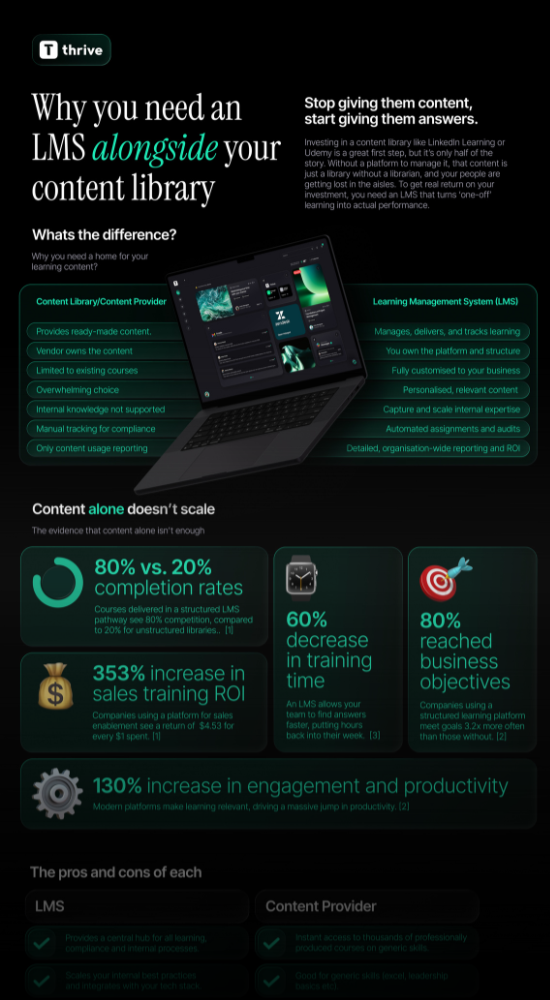
[Download the infographic: “Why you need an LMS alongside your content library”, and share it with exec to get the buy-in you need]
Pitching the difference: Strategy vs. material
The biggest hurdle in an exec meeting is defining the difference between these two terms. Think of a content provider as the books on the shelf, with thousands of expert-led, ready-made courses on generic skills.
But an LMS is the library building itself. It is the infrastructure that powers learning across the organisation.
Here are the key structural differences:
Ownership and structure
With a content library, the vendor owns the material and the experience. With an LMS, you own the platform and the structure, allowing you to tailor everything to your business needs.
Internal knowledge vs. generic expertise
Content libraries are great for universal skills like leadership basics. But they can’t capture your company’s "secret sauce." An LMS allows you to capture and scale internal expertise and user-generated content that no external vendor can provide.
Compliance and accountability
You can’t run a business on "optional" learning. While content libraries are usually learner-led, an LMS provides the strong reporting, assignments and audits needed to manage mandatory compliance and role-specific training.
Crucially, while a vendor owns the content in a library, you own the platform and the strategy in an LMS.
The stats that demonstrate the impact
CFOs (and CEOs) care about waste. If you’re paying for a library that nobody is visiting, that’s a leak in your budget. Use the data points, and the high-level impact, to bridge that gap.
The 80% completion gap
The stat: Courses in structured LMS pathways see 80% completion, compared to just 20% for unstructured libraries (Continu, 2025).
How to pitch it: "Right now, we are potentially wasting 80% of our content budget because our team is overwhelmed by choice. By adding an LMS, we aren’t just buying more ‘stuff’; we’re buying the guidance system. We can take those same courses and put them into bite-sized, mandatory pathways that ensure 80% of our managers are actually learning the skills we’ve already paid for."
Note that quadrupling completion rates doesn’t just mean “more videos watched”. This is about standardisation of excellence. It means 80% of your managers are now using the same feedback framework, rather than 20% trying to lead while the other 80% wing it. It creates a unified culture of “how we do things here”.
The business objective multiplier
The stat: Companies using a structured platform meet business goals 3.2x more often than those who simply provide content (Coursebox AI, 2026).
How to pitch it: “Our executive team sets quarterly goals, but our current learning library is completely disconnected from them. With an LMS, we can align specific learning tracks with our KPIs. If we need to improve customer retention this quarter, we don’t just hope people watch a ‘Customer Service’ video. We assign it, track it and measure the impact. This moves L&D from a ‘perk’ to a direct driver of our strategic objectives.”
This bridges that gap between the knowing and the doing. Meeting objectives 3.2x more often means your training is an active participant in revenue growth and operational efficiency.
The 60% efficiency gain
The stat: An LMS can shorten training time by up to 60% (iSpring Solutions, 2026.)
How to pitch it: “The biggest complaint we hear is that people 'don't have time to learn’. That’s because they are wasting time searching for answers across five different platforms and internal folders. An LMS consolidates all our knowledge into one ‘Searchable Answer Engine’. By shortening the time it takes to get an answer by 60%, we aren’t just training them faster; we are giving them hours of productive time back to do their actual jobs.”
This is a pure productivity win. For a team of 100, saving even small amounts of time through better knowledge access is equivalent to adding several hundred hours of capacity to the business every month without increasing headcount.
The Sales ROI (353%)
The stat: Using an LMS for sales enablement brings back $4.53 for every $1 spent (Continu, 2025).
How to pitch it: “This is the most direct ROI we can show. By using an LMS to host our custom sales playbooks alongside external recognition content, we can onboard new reps 40% faster and get them hitting quota sooner. This isn’t an L&D expense; it’s a revenue engine that pays for itself four times over by ensuring every salesperson is pitching with the same high-level expertise.”
This translates to market agility. When you launch a new product or change pricing, an LMS ensures your entire global sales force is ‘on message’ within 24 hours. Combine that with existing, more generic sales content and you’re unstoppable.
Better together is your strongest argument
The strongest learning ecosystems use both. You aren’t asking to replace your content; you’re asking for the tool that makes it work harder.
Expertise meets context
Content is king because a content library provides the video on ‘leadership’. But the LMS takes that video and wraps it in context. Adding your specific HR checklists, your company values and matching the learner with a mentor (if using Thrive).
You also get one consistent home. Instead of sending people to five different websites, an LMS creates a single ‘digital front door’, turning a fragmented experience into a unified culture.
The pitch: “Think of our content library as a giant warehouse of ingredients. It’s high quality, but our employees aren’t chefs - they’re busy people who need a meal. An LMS is the kitchen. It allows us to take those ingredients and create specific ‘recipes’ (learning pathways) for our New Managers or Sales Reps. We can wrap a generic negotiation video in our specific company values, add our internal pricing checklists and match the learner with a mentor. We move from giving them ‘expertise’ to giving them ‘context’ on how to succeed at THIS company.”
Turn usage into business intelligence
One of the most dangerous myths in L&D is that “views” = “value.”
A content library can tell you how many people clicked a link, but it can’t tell you if your team is actually ready to meet the challenges of next year. To get true buy-in, you have to show leadership that an LMS isn’t just a record-keeper, it’s a data-driven heat map of your company’s capabilities.
The pitch: “One of the biggest risks of a content-only approach is that we only see what people ‘used’. We have no idea if they actually ‘know’ the material or if they are applying it. An LMS gives us holistic reporting. It moves the conversation from ‘who logged in?’ to ‘where are our skills gaps?’.
If 40% of our team is searching for ‘how to handle objectives’ but our sales figures are dipping, we’ve identified a skill gap in real-time. This isn’t just HR data; it’s a heat map for the business. It allows us to be proactive, ensuring our workforce is actually ready for our next big market shift, rather than reacting after the fact.”
Why should you buy first?
A bit like the “chicken and egg” debate, do you buy the library or the platform first? The trust is, it depends. You need content to make an LMS look inviting and useful on day one, but you need an LMS to ensure that content actually gets seen.
If the budget only allows for one, be prepared to justify your priority:
Start with content if…
You are building your L&D function from scratch and have zero internal resources to build your own content. You need to prove that ‘learning’ is value-add before you invest in the infrastructure. Buying content first gives you something to ‘put in the window’.
Start with LMS if…
You already have internal experts, standard operating procedures and onboarding documents. Most likely, you’re reading this because you already have the content (and it’s sitting in messy content libraries). In this case, the LMS is the immediate priority to save that content from becoming ‘shelfware’.
Pitching both at once
If you have the opportunity to buy both, don’t pitch them as two separate expenses. Pitch them as a unified learning ecosystem.
“If we buy content without a platform, we lose 80% of our engagement. If we buy a platform with content, we spend six months building before we see value. By going with a provider like Thrive, we got both a high-quality content library and the LMS to host it on. We avoid the headache of managing multiple vendors and get experts to help us build both pathways and bespoke content from day one. It’s the only way to ensure 100% of this budget is actually working for the business without the leg work.”