The AI-powered workplace: how smart search transforms the way your people work
When your people can't find what they need, they stop looking. Here's how AI-powered search in your learning platform closes the gap — and what it means for L&D.

Half of all workers who use AI say it saves them meaningful time. That's the finding from Anthropic's What 81,000 People Want from AI report, published this month — the largest qualitative study of AI use ever conducted.
The single biggest thing people want AI to do at work is handle routine tasks so they can focus on higher-value work. And buried inside "the routine stuff" (e.g. the searching, the sifting, the sending-a-message-to-find-a-document) is a huge amount of daily friction that most organisations haven't fully reckoned with.
Information exists, but finding it is still the hard part.
That’s where smart search comes in.
What AI changes about search
Traditional search is keyword-dependent. Type in the wrong phrase and you get nothing useful. Type a slightly different variation, and suddenly a whole library of relevant material appears.
AI-powered search works differently. Rather than matching words, it actually understands intent. It can look at what someone is searching for, factor in their role and previous activity, consider what people like them have found useful, and surface content that genuinely fits the moment.
For example, a sales manager searching for "handling objections" might get a different set of results compared to someone in customer success asking the same question. Both are relevant. Both are right.
There's also the aggregation problem. Most people at work aren't searching in one place. They’re entering into a minutes-long negotiation that involves checking their LMS, then their intranet, then Slack, then giving up and asking a colleague, who has to go on their own wild goose chase.
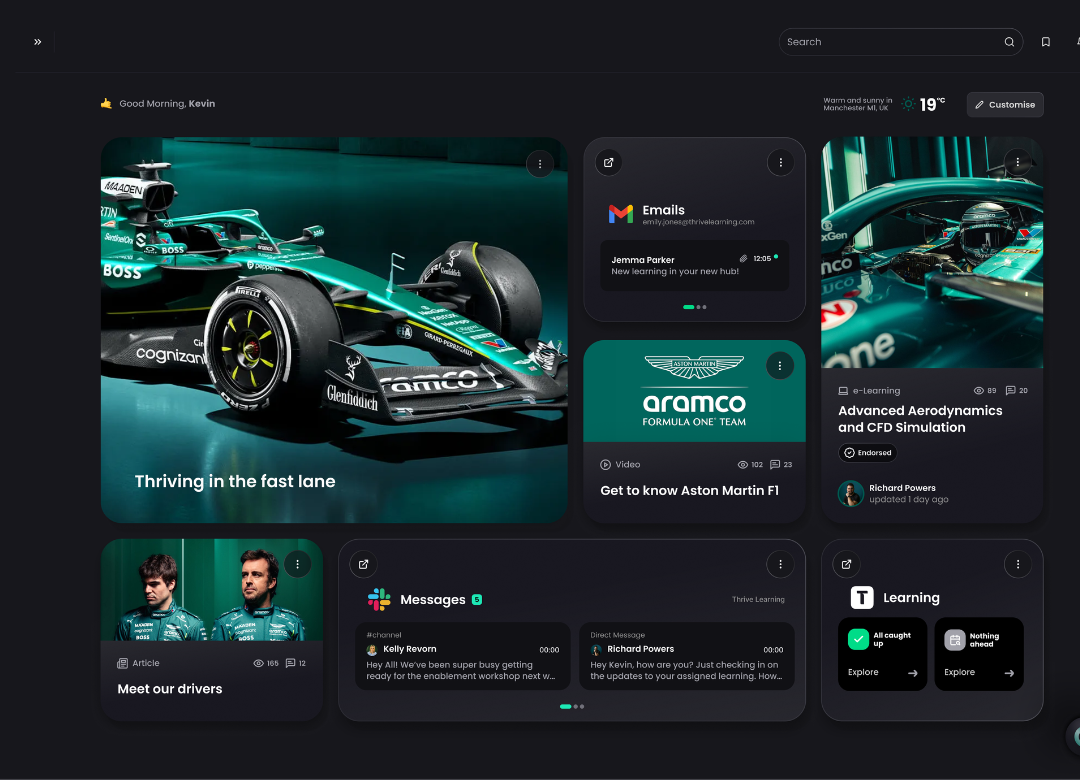
AI-powered search mitigates this by bringing all of those sources into a single, coherent experience – so your people don't have to remember where things live. They just have to ask.
Search as part of the learning experience
Here's where it gets particularly interesting for L&D teams. Building search into your learning platform takes it beyond just being a utility, and turns it into the kind of useful learning nudge we’re always coveting.
Say someone searches for a course on giving feedback. A smart system won’t just return the most viewed result. Instead, it may surface:
- A short video from a peer
- A relevant article
- A pathway your learner has yet to complete
- A note that their manager recently bookmarked
… and anything else that could be relevant to them at that moment. This turns their query from a simple search into a personalised learning moment, delivered at the exact point of need.
The best learning platforms will treat search both as a core part of the experience, and as an engine for learning. It should never be treated as a mere afterthought tucked into the navigation bar. When search and recommendations work together like this, every query becomes an entry point into something richer, and when those results are constantly relevant, people implicitly trust the platform.
This means that they keep coming back and share what they find without a second thought.
That shift (from a platform people open under duress to one they actually want to use) is where the real value lies.
What this means for L&D teams
For the people responsible for building and maintaining learning content, smart search creates a genuinely useful feedback loop. You can see what people are searching for — and crucially, what they're not finding.
Every failed search is a signal: Here's a gap, and here's what your people need in order to fill it. That's valuable in a way that traditional data rarely is. Rather than guessing what to create next, you're working from real demand. The search bar becomes one of your best diagnostics.
It also shifts how you think about curation. When AI can surface the right content at the right moment, you don't need to maintain vast, perfectly organised libraries. You just need good content, tagged well enough for the system to understand it, and the technology handles connecting it to the people who need it.
Making it work in practice
Obviously, smart search won’t fix poor content. If the underlying material is outdated or just not very good, no amount of AI will make it useful. The technology amplifies what's already there, which means the quality of your content library still matters enormously.
Building trust with your workforce also matters. Some people will search once, get a result that doesn't feel relevant, and never come back. That first experience is hard to undo. Getting the basics right (e.g. clear titles, useful descriptions, sensible tags) is still foundational work, even in an AI-powered world.
For global organisations, there's a localisation dimension as well. Search that works brilliantly in English but returns nothing useful in French or German isn't solving the problem for everyone. Smart search needs to be genuinely multilingual if it's going to serve a diverse workforce fairly.
The bigger picture
In Anthropic's research, nearly a third of people said they want AI to handle the tasks that drain their time and attention — not to replace the work that matters, but to make more room for it. That framing applies directly to how people experience information at work.
The goal isn't a faster search bar. It's a workplace where your people spend more time doing the things they're good at, and less time trying to find what they need.
AI-powered search, embedded into a learning experience that already knows what your people need, can genuinely move that dial. Over time, across thousands of employees and hundreds of daily moments of need, those gains add up to something worth building toward: a workforce that's better informed and more able to grow.
Interested in learning more?
Thrive’s federated search feature finds accurate answers instantly by scouring your platform, the internet, and all your connected systems in a matter of seconds – all in one place.
To find out how AI-powered search could help your business, book a demo today.