Is your LMS AI-ready? 5 questions that reveal the truth
The ultimate test for whether your LMS is truly AI-ready

Is your LMS AI-ready? Here’s your ultimate checklist to help you determine the answer.
If you’re in the midst of vendor conversations right now, you’re probably finding yourself in a loop, returning again and again to the same question: Does this LMS have the AI capabilities we need?
It’s no longer a question of whether an LMS has, or is compatible with, AI. Everything, from online word processors to the app that tracks our pizza toppings before they leave the kitchen (yes, really) has an AI plugin.
So with that in mind, what questions do you need to ask to determine whether your potential LMS has AI capabilities that are right for your organisation?
“Don't ask if your LMS has AI. Ask if your organisation's AI can use your LMS. Those are different questions — and only one of them matters in 2026.”
The five questions that reveal AI readiness
1. Can an AI agent – not just a chatbot – read your LMS data?
Only if the platform exposes structured, machine-readable data beyond its chatbot layer, and most don't.
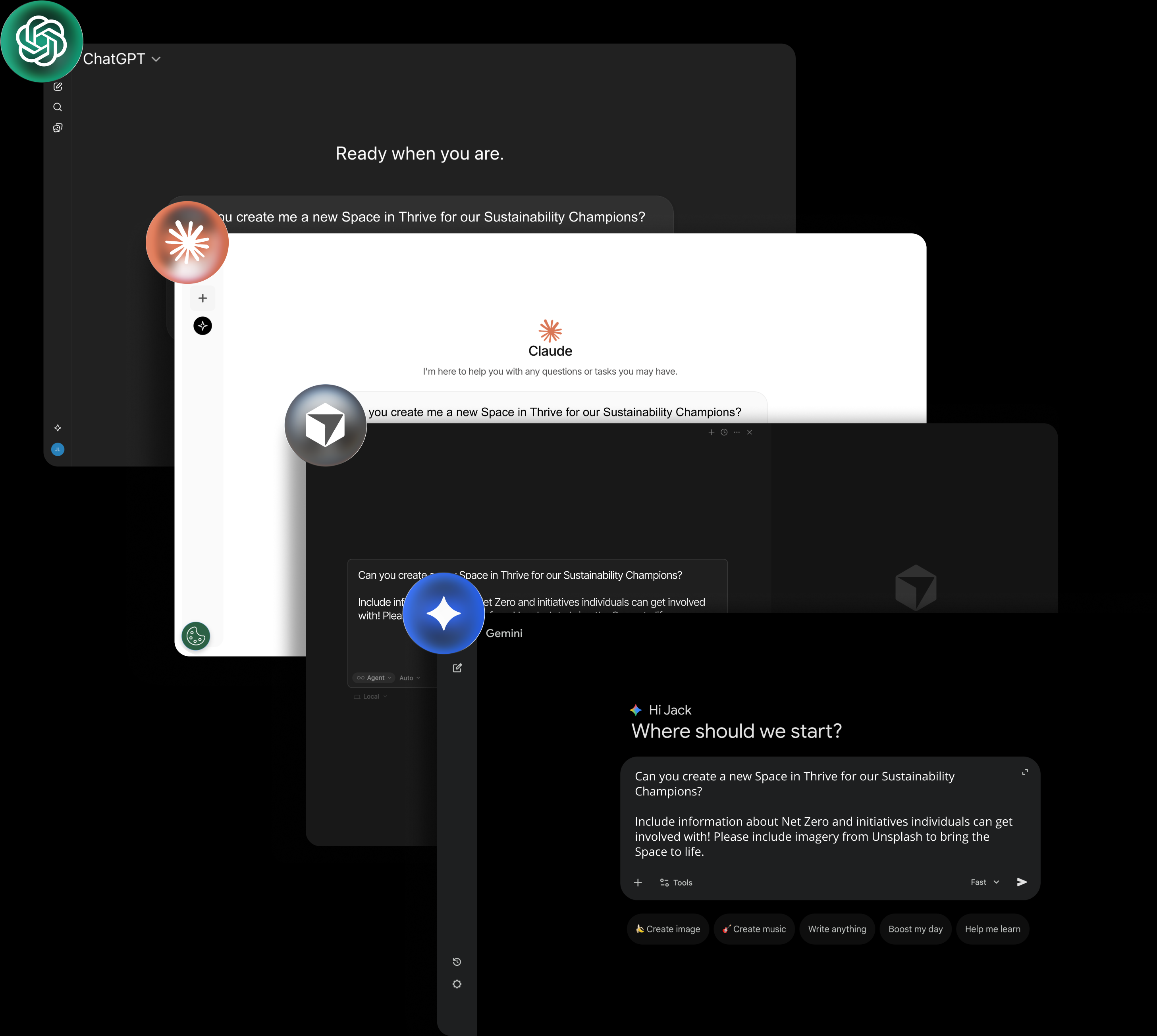
By now, most LMS platforms have some sort of chatbot built into the interface. It's usually a conversational layer sitting on top of the platform, built to answer learner questions typed into a box. That has nothing to do with whether an external AI agent, the kind your organisation might deploy through Copilot, Claude, or an internal orchestration tool, can actually query the underlying data.
An AI agent needs structured, machine-readable access to completion records, skills data, learner progress and course metadata. In practice, that means a documented API or an MCP server the agent can connect to directly, rather than a scraped export or a support-ticket workaround. Without that access, the agent has nothing to work with, regardless of how well the chatbot can hold a conversation.
This is the most basic test of AI readiness, and every other question in this piece builds on it.
2. Does your LMS have an MCP server, or an equivalent open standard?
Most don't yet, and a standard API isn't a substitute for one.
When asked about interoperability, a lot of vendors will point to their API.
It’s important to bear this distinction in mind: An API ≠ an open standard built for AI agents.
An MCP server gives an AI agent a consistent, documented way to connect to a platform, without a developer having to build and maintain a custom integration for every agent that wants access.
A bespoke API can technically expose data too, but it usually means a new integration project every time your organisation adopts a new AI tool, which is precisely the friction MCP was built to remove.
Ask a vendor directly whether they support MCP, and if the answer is no, ask what their roadmap looks like. A well-built API without an open standard behind it is still workable today. It’s unlikely to stay that way as more agents enter the market expecting a common protocol rather than a one-off integration.
3. Can an AI agent take action in your LMS, instead of just retrieving information?
Only if the platform supports write access rather than read-only access, which is where most vendors fall short.
Reading data and acting on it are two different capabilities, and this is where most AI-ready claims start to crumble. A read-only integration lets an agent answer a single question, for example: “How many people completed this course?”
That’s obviously useful information, but it crucially stops short of anything an L&D team would call automation.
The real test is whether an agent can enrol a learner onto a pathway, update a completion record, or trigger a workflow… all without a human having to manually click through the platform in order to make it happen.
Vendors are far more likely to have solved read access than write access, since letting an external agent change data raises harder questions about permissions and error handling. It’s worth asking a vendor for a specific example of an agent taking an action inside their platform, rather than accepting a general answer about "API capabilities."
4. Is your content structured for machines as well as humans?
Only if it carries consistent metadata and skills tagging, which a lot of content libraries lack.
An AI agent can have full read and write access to an LMS and still be useless if the content inside it has no real structure.
Metadata, tagging, skills mapping and consistent content architecture are what let an agent understand what a piece of content actually is, not just that it exists. A course with no skills tags attached is invisible to an agent trying to match learning content to a specific capability gap. A content library with inconsistent naming conventions is just as hard for an agent to navigate as it is for a learner.
This is often the least visible of the five questions, since it has nothing to do with AI itself and everything to do with content discipline that should have been in place years before AI entered the conversation. Ask whether your vendor can show a genuine example of skills-based content tagging.
5. Who is accountable when an AI agent acts on your data?
Accountability should sit with whoever defined the agent's permissions and audit trail before it was given access.
This is the question procurement teams tend to ask last, if they ask it at all. It should be closer to the top of the list.
Once an agent can act on data rather than just read it, governance stops being optional. Who approved that action? What permissions did the agent have? Is there an audit trail showing what changed and why? These are the first things to check when something goes wrong, and the answer needs to exist before an incident happens.
A vendor who has genuinely thought about AI readiness will have clear answers on permissioning and audit logging. A vendor who has bolted on a chatbot will usually not have considered this at all, since a chatbot answering questions was never in a position to change anything.
What genuine AI-readiness looks like
Pull these five questions together and a single standard emerges. An AI-ready LMS is one an external agent can read from, act on, and be trusted with, built on content that's structured well enough to be understood, with governance in place before anything goes wrong rather than after.
That's a meaningfully higher bar than most vendor conversations currently operate at. A chatbot answering learner questions meets none of it. An open API with no MCP support meets part of it. A platform that lets an agent read data but never act on it meets less of it than it first appears. Genuine AI-readiness only exists where all five conditions hold at once, which is exactly why it's worth testing for directly rather than accepting a vendor's word for it.
The organisations set up to benefit from agentic AI in the next few years will be the ones that ran this test now, not the ones that assumed a chatbot on the homepage meant the job was already done.
A quick self-assessment checklist
Run your LMS against these five questions before your next vendor conversation.
- Can an AI agent, not just a chatbot, read your data?
- Does your platform have an MCP server, or an equivalent open standard?
- Can an agent act on your data, not just retrieve it?
- Is your content structured well enough for a machine to understand it?
- Is there a clear line of accountability when an agent acts on your data?
A yes to all five puts a platform in a small category. A no to any of them is worth raising with a vendor directly, before it becomes a problem rather than a question.
Take a look at how Thrive's MCP server works, or to see it in action, book a demo today.
FAQs
- What does it mean for an LMS to be AI-ready?
An AI-ready LMS is one that external AI agents can read from, act on and be governed around, rather than a platform that simply has a chatbot layered onto its interface. Genuine readiness depends on structured content, an open standard such as MCP, and clear accountability for any action an agent takes on the platform's data.
- What is an MCP server in the context of an LMS?
An MCP server gives AI agents a consistent, documented way to connect to a learning platform without a developer building a bespoke integration for every new tool. It functions as an open standard for interoperability, allowing agents such as Copilot or Claude to query and, where permitted, act on an LMS's data using a shared protocol rather than a custom-built connection.
- How is an AI agent different from an LMS chatbot?
A chatbot responds to natural language typed into a box and sits as a conversational layer on top of the platform. An AI agent operates differently: it needs structured, machine-readable access to underlying data such as completion records, skills data and course metadata, and in more advanced cases can take direct action on that data, such as enrolling a learner or updating a record.
- What should organisations ask LMS vendors about AI readiness?
Organisations are advised to ask vendors whether an external AI agent can read the platform's data, whether the platform supports MCP or an equivalent open standard, and whether an agent can take action on that data rather than only retrieve it. Questions about content structure and governance, including who is accountable when an agent acts on platform data, are equally important and often overlooked.
- Why does AI readiness matter for an LMS in 2026?
As organisations adopt AI agents across their existing tools, an LMS that cannot be read from or acted on by those agents becomes disconnected from the rest of the AI stack. Readiness matters because it determines whether a learning platform can participate in an organisation's wider AI strategy, rather than sitting apart from it as agent-based workflows become standard practice.