Using your LMS to strengthen your internal communications strategy
How your learning platform can become a central hub for company-wide communication

Employees lose more than 35 working days a year to poor communication.
That's $10,140 in wasted salary, per employee, per year. (Or £7,475, to stop you having to Google the exchange rate.)
So what exactly does 'poor communication' look like? If your internal communications strategy is separate from your learning strategy, you might be closer to it than you think.
This is the case for a lot of organisations: Their Learning & Development function lives on one platform, while their internal communications tools sit in another. And ironically, the two don't communicate. But your LMS – hopefully! – already reaches your entire workforce in one efficient swoop. That makes it an obvious candidate for internal comms.
Why internal comms strategy and L&D overlap
What is internal communications, really? At its simplest, it’s every piece of information your organisation sends to its workforce to keep them informed and engaged. Internal communications is such an inextricable part of L&D, it's a wonder they're ever spoken about separately. After all, keeping the workforce informed and engaged is at the core of L&D's value proposition – whether that's about a company-wide initiative or annual safety training.
Another, less ideal thing both have in common: They compete for your workforce's incredibly valuable attention and time. As a result, they arguably get pushed down the to-do list when there are more urgent tasks taking a front seat.
So how can you make both more efficient – and at the same time, eradicate the need to duplicate your effort across multiple functions?
The answer, of course, lies in combining them.
What an LMS can do beyond delivering training
If you're reading this, the chances are you're already aware that an LMS's actual value far exceeds its ability to deliver annual health and safety training. But if you don't know the finer details, here are just a few ways that your LMS can support internal communications.
Company-wide announcements: Campaigns let you push a message to your entire workforce in one go, without relying on a company-wide email that half your people will skim past. Because the campaign lives in the same platform your people already use for learning, it arrives alongside something they're checking regularly rather than competing with an already-overflowing inbox.
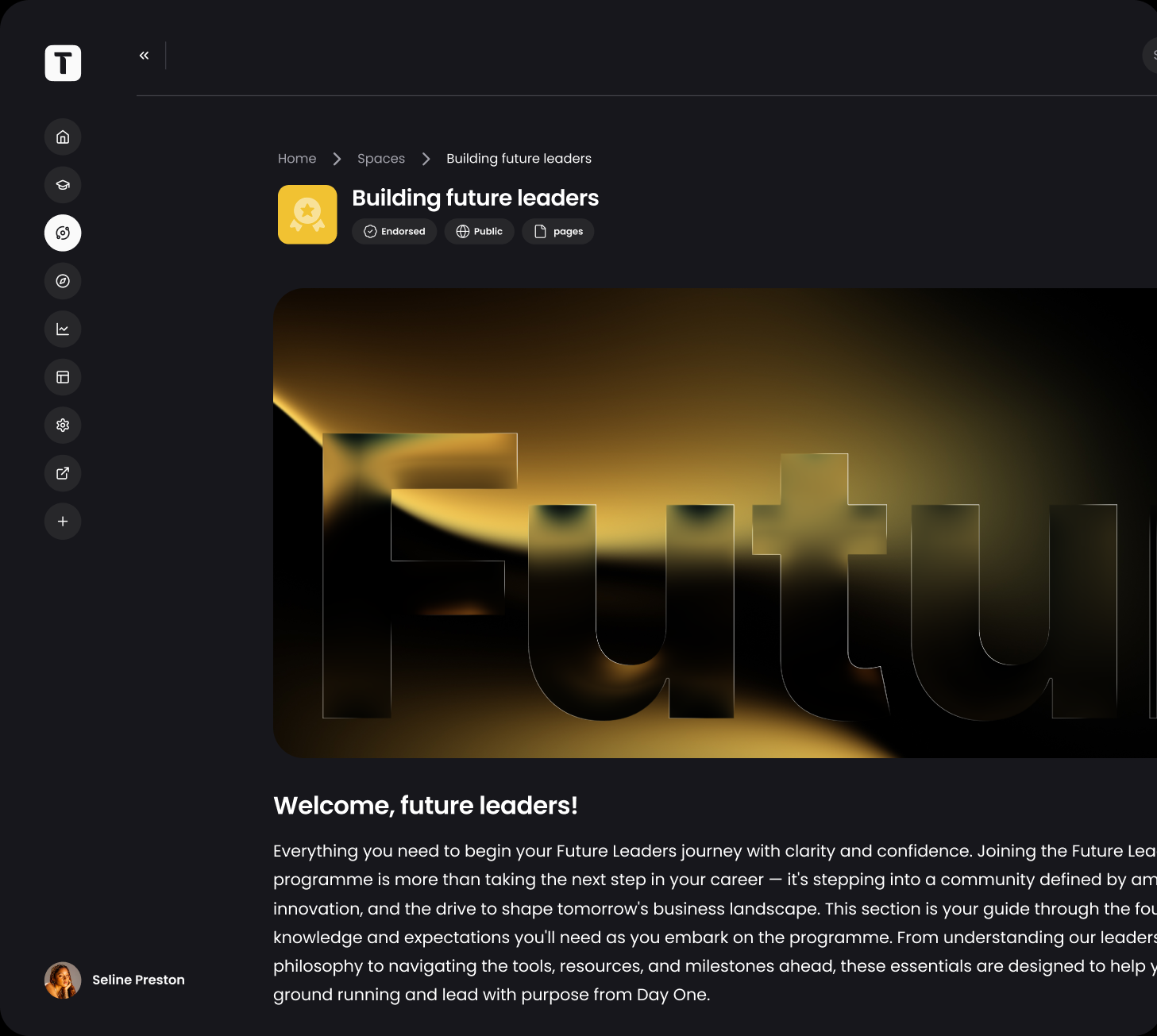
Spaces for common interests: Spaces bring people together around a shared topic, team, or community of practice, combining social feeds, chat, and user-generated content in one place. Instead of a Slack channel that fills with ignorable, meaningless noise, a Space keeps the conversation connected to the learning content and people it relates to.
Chat: Real-time messaging built directly into the platform means conversations don't disappear the moment a session ends. Every exchange is stored and searchable, so mentors, mentees, peers, and managers can message each other without switching tools, and the context behind a conversation, whether that's progress on a goal or a shared piece of content, builds naturally over time instead of starting from scratch.
Segmented messaging: Targeted notifications and campaigns mean the right message reaches the right people, rather than everyone receiving everything regardless of relevance. Each update goes straight to the people it affects, and admins can send timely, personalised nudges with the immediacy of a direct message.
The benefits of consolidating communication into your LMS
The term “A single source of truth” has had a resurgence in recent years, and we can't help wondering if the reason for that is deeper than it being a catchy phrase.
It's perhaps evidence that people are getting bored with constant context-switching, toggling between different apps and tools, and fruitlessly chasing down the right answer. This strategy addresses the issue by providing one place for employees to find those answers.
This also reduces the dreaded ‘email fatigue’ – that's the visceral burnout that employees feel as a result of the constant deluge of emails, meetings, and instant messages, which is having a real impact on the workforce. This survey estimated that 38% of office workers cited this phenomenon as a reason to quit their jobs. By consolidating internal communication and learning into one platform, you're preventing that fatigue before it takes hold.
For larger organisations juggling internal corporate communications across multiple sites or regions, this matters even more.
Another huge benefit of this strategy is that it's trackable. You can actually see (not just feel) the impact of your efforts, and monitor specific metrics like opens, completions, shares, likes, and comments.
That leads to better data, which leads to more effective internal communication, not to mention easier reporting for HR, Comms, and L&D.
How to bring internal comms into your LMS strategy
Getting this right is what separates ad hoc updates from strategic internal communications, so if you’re ready to get started, here are a few steps you can take:
- Map current communication channels and identify overlap with L&D content
As always, the best place to start is by reviewing what you’re already doing. Audit where your organisation currently sends updates, announcements, and training content. Look for the overlap: policy updates that get emailed out, repeated in a compliance module, or buried in an internal memo nobody rereads, alongside onboarding information that lives in three different places depending on who set it up. This overlap is usually where the duplicated effort is hiding.
- Define what belongs in the LMS versus other channels, such as Slack or email
Not every message needs a home in your LMS. Time-sensitive, conversational updates are still better suited to Slack or email, while anything that needs to be tracked or tied to a learning record (policy changes, compliance deadlines, role-specific guidance) belongs in the LMS, where completion and comprehension can actually be measured.
- Involve comms and L&D teams jointly in planning, so ownership is agreed before anything is built
This is where most consolidation attempts stall. Comms teams and L&D teams often have different reporting lines, different tools, and different definitions of success, so getting both in the room early avoids a situation where the LMS becomes a dumping ground for content nobody's maintaining. Agree ownership and update cadence upfron
- Set up automated triggers for key moments, such as a new starter, a policy update, or a compliance deadline
Once channels and ownership are clear, automation is what makes the strategy sustainable rather than a one-off project. A new starter should automatically receive onboarding content without someone manually assigning it, and a policy change should trigger a targeted update to only the roles it affects, rather than a company-wide email.
- Pilot the approach with a single use case before rolling it out more widely
Rather than restructuring every channel at once, choose one high-friction area, onboarding is a common starting point, and run the new approach there first. It's easier to prove the value and iron out ownership issues on a contained pilot than to fix them after a full rollout.
- Measure engagement and adjust based on what employees actually open and act on
Your LMS should already give you visibility into completion rates and content engagement in a way that email and Slack can't. Use that data to see what's landing and what's being ignored, and adjust the channel mix accordingly rather than assuming the plan is working.
The LMS is already the tool you need
Bringing internal comms and L&D together means recognising what your LMS can already do, and giving it room to do it, rather than building something new.
If you're ready to see what that looks like for your organisation, get in touch with the Thrive team for a walkthrough of how Spaces, campaigns, and segmented messaging can work together inside your platform.