Skills intelligence: why AI readiness fails without it
Self-ratings fail for new, complex skills like AI. Here's how a skills intelligence platform fixes that.

Skills intelligence is a live, evidence-based view of what your people can actually do, mapped to the roles they hold and the skills those roles need next. Without it, AI readiness programmes measure access to tools, not the ability to use them well.
Most organisations rolling out AI tools in 2026 have hit the same wall. The licences are live, leadership has declared the business "AI-enabled", and yet productivity hasn't moved. Adoption is patchy. L&D teams keep hearing the same question from every corner of the business: why isn't this working?
The answer is almost never the technology. It's the missing picture of what employees can actually do, and the lack of a structured way to close the gaps that picture reveals.
This article covers why AI readiness is a skills problem first, what a working skills intelligence platform looks like, and how L&D leaders can build one without waiting for a perfect taxonomy.
Deploying AI tools is not the same as business AI readiness
The two get used interchangeably, and that's where most programmes go wrong.
AI tool deployment is a procurement and IT decision. You buy a tool, configure it, roll it out and track licence activations. It has a start date and a go-live.
Business AI readiness is a capability state. It describes whether your workforce can use AI tools well, adapt as those tools change, and judge when AI output needs a human check. It doesn't finish at go-live, and it shifts every time the tools do.
The distinction matters because most organisations are measuring the wrong thing. Completion rates and activations show that people have been given access. They say nothing about whether those people can act on what the tools produce.
I think, therefore I can: the problem with self-rated skills
Descartes built modern philosophy on "I think, therefore I am". Most skills data is built on "I think I can, therefore I can". When AI is changing what every role needs, that's a costly assumption.
When organisations try to measure AI readiness, they usually start with a survey. Employees rate their own confidence, managers skim the results, and L&D builds a training plan on top.
The research on self-assessment should give every L&D leader pause. A metasynthesis of 22 meta-analyses by Zell and Krizan (2014) found only a moderate link between how people rate their abilities and how they actually perform. The link was stronger when tasks were objective, familiar and simple. AI skills are none of those things. They're new, complex and changing every quarter, so self-ratings are least reliable exactly where AI readiness needs them most.
A training plan built on self-ratings assigns courses to people who don't need them and misses the people who do. The real capability gap stays invisible until something goes wrong.
What you need instead is evidence: role-specific skills data validated by managers and observed assessments, which updates as people learn and apply new capabilities.
What a skills intelligence platform actually does
"Skills intelligence" gets used for everything from a spreadsheet taxonomy to a competency framework PDF. It's worth being precise, because the difference between a skills list and a live system is the difference between a photograph and a live feed.
A skills framework is a structured list of the capabilities your organisation cares about. It's a useful starting point. On its own, it tells you very little about who can do what.
A skills intelligence platform, sometimes sold as skills intelligence software, turns that framework into live data. Whatever the label, it should do five things:
- Skills mapped to roles, with clear levels for each
- Skill levels set and validated by managers, not just self-declared
- Observed assessments that log verifiable evidence of on-the-job competence
- Skill levels that rise when that evidence is captured
- Skills connected to goals, CPD and learning content, so gaps link directly to development
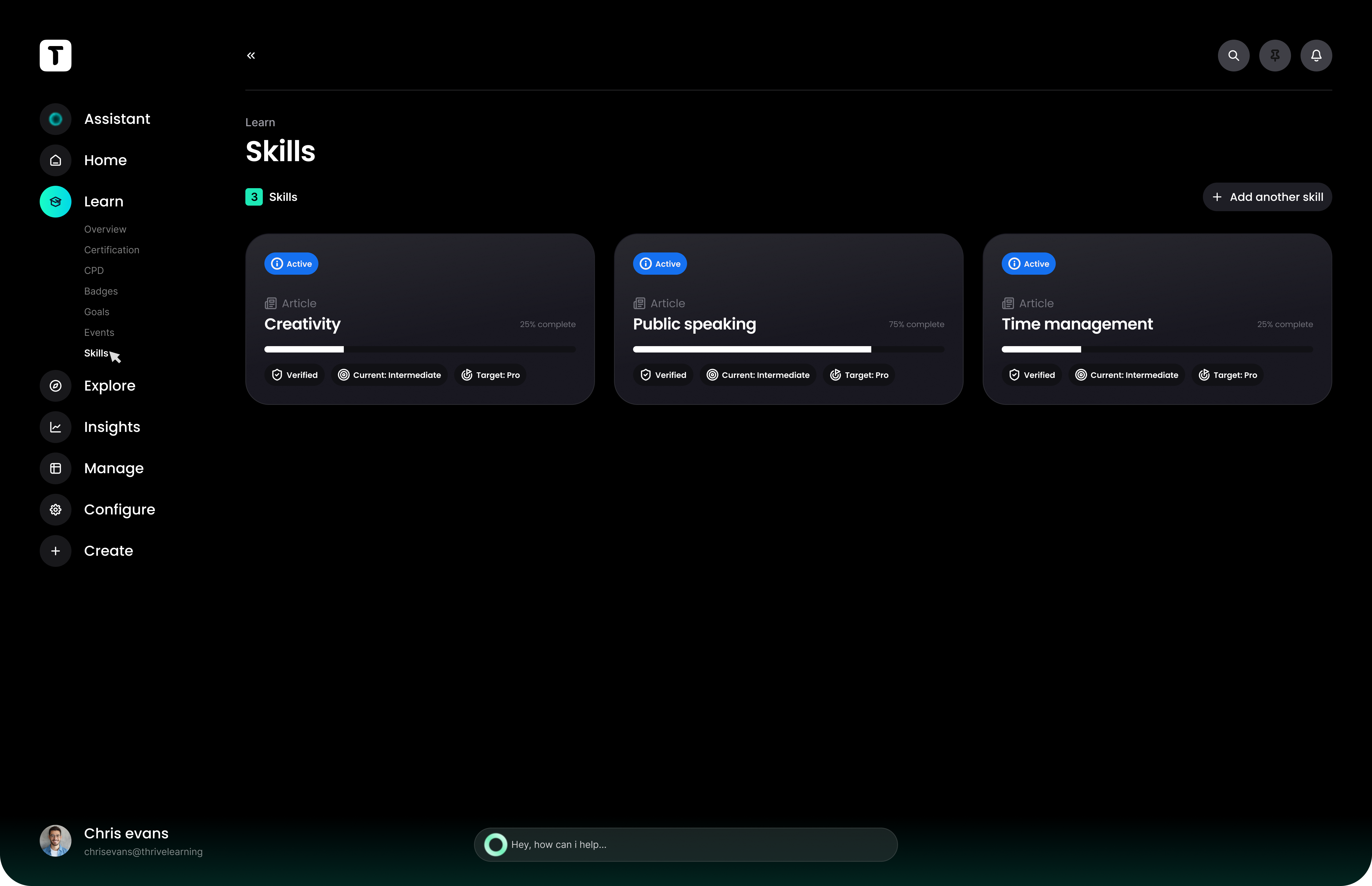
This is how skills work in Thrive. Admins configure up to ten skill levels. Managers set current and target levels for their teams, and observed assessments let managers record real-world competence against each learner's profile. When an employee completes a skills assessment or task, the level updates automatically. The data reflects what people have shown they can do, not what they say they can do.
The three signals that matter for AI readiness
- Current capability: what employees can demonstrably do today. This separates people who are genuinely ready from those who have just finished a course.
- Role-level demand: what each role needs as AI tools change the job. This is the foundation of skills based workforce planning, and it stops generic training that doesn't match real work.
- Evidence of application: whether skills are being used in practice. This is what separates capability from compliance.
Most organisations can see one or two of these. Very few see all three in one connected system, and that gap is why AI readiness programmes stall after the first training push.
Where AI-powered skills intelligence comes in
A skills intelligence platform tells you where the gaps are. AI helps close them faster.
Kiki coaches in the flow of work. Once a gap is identified, Kiki, Thrive's AI agent, reinforces learning with AI-generated challenges, reflective prompts and scenario-based exercises. Employees practise the skill in context, on the work in front of them.
Mentor matching runs on skills data. Thrive Mentoring matches mentors and mentees on skills, goals, roles and experience. The colleague who already uses AI tools well gets paired with the one who's just starting. It's included at no extra cost in the LMS, or available standalone.
Analytics show where teams stand. Learning analytics give L&D and managers visibility of engagement and skills progress by team, so development conversations start with data rather than gut feel.
Why fragmented tools produce fragmented results
The typical enterprise L&D stack in 2026 is an LMS for formal learning, a separate skills or talent tool, a performance system and often a mentoring tool bolted on the side. Each captures part of the picture. None of them talk to each other properly.
We see the same pattern when organisations move to Thrive from a collection of point tools. The skills data exists, but nobody trusts it enough to act on it. Connecting HR systems such as Workday to the learning platform is usually the first fix, because role and people data stops living in a separate silo.
That fragmentation undermines AI readiness in three ways.
1. Skills data goes stale
When skills live in a separate system from learning, they only update when someone refreshes them manually, usually at the annual review. For AI skills, where requirements shift quarter by quarter, a stale skills inventory is worse than none at all. It creates false confidence.
2. Learning disconnects from development
If the learning platform can't see skills data, it can't personalise development to real gaps. The person who uses AI tools daily and the person who has never opened one sit through the same AI literacy course. Neither gets what they need.
3. Managers can't act on what they can't see
Even when L&D has a reasonable view of gaps, that insight rarely reaches line managers. Without team-level visibility, development conversations happen without data and coaching stays reactive.
The result is that AI readiness stays an L&D initiative rather than a business outcome.
A five-step AI readiness framework
Building skills intelligence for AI readiness doesn't need a multi-year transformation. It needs the right pieces connected in the right order, and the willingness to start before the taxonomy is perfect.
Step 1: Define AI skills for each role
"AI literacy" is too broad to measure. The skills that matter are specific to roles. A customer service manager needs to critically evaluate AI-suggested responses. A finance analyst needs to validate AI-produced models. A content creator needs to know where AI output needs human judgement before it's published.
Start with three to five AI-related skills for each role family, tied to the outcomes those roles own.
This is skills-based workforce planning in practice. You plan around the skills each role needs, not the job titles on the org chart.
Starting narrow works. When British Airways built its Wings mentoring programme on Thrive, the team narrowed an initial list of 50 skills down to ten core areas. The programme hit a 70% mentoring match rate within eight weeks.
Step 2: Capture evidence of capability
Once skills are defined, validate them. A useful AI readiness assessment relies on manager-set levels and skill assessments that capture evidence of what people can do. Confidence is a different measure entirely. Good skills assessment software builds this into your LMS, so evidence is captured where learning already happens. A short, scenario-based assessment gives a far more reliable baseline than a 50-question self-evaluation form.
Step 3: Connect gaps to learning pathways
Closing a skills gap rarely takes one course. For AI readiness, the journey usually includes:
- Foundational learning: how the specific AI tool works and what it's designed for
- Guided practice: low-stakes activities that build confidence with the tool
- Peer learning: knowledge shared by colleagues already using the tool well, often in social learning spaces
- Mentoring: targeted support from an experienced practitioner
- Assessment: evidence that confirms the gap has closed
Learning pathways bring these steps together, so employees don't have to jump between tools. The fewer the friction points, the more likely development actually happens.
Step 4: Give managers real-time visibility
L&D can't be the only team tracking AI readiness. Line managers need to see, at a glance, where their teams are strong and where gaps remain. With employee skill tracking, that picture updates as people complete assessments and tasks. Used well, it turns the regular one-to-one into a development conversation backed by data.
Step 5: Measure capability progression, not completions
Completion rates tell the board that people sat through training. Capability progression tells them people can now do something they couldn't before. The metrics that show real progress are:
- Skills gap closure rate: the percentage of identified AI skill gaps closed over a set period
- Level progression: movement in validated skill levels from baseline
- Application evidence: manager-validated proof of AI skills used in role, the core of transfer of training
- Internal mobility: employees moving into roles that need higher AI capability
These metrics only exist when skills data, learning data and assessment data sit in one system.
The mentoring layer most organisations miss
Most AI readiness programmes focus on content: courses, videos, guides. They underinvest in the human layer that turns knowledge into judgement.
AI skills are learned mostly through practice and observation. Watching a colleague use an AI tool on a real problem, then trying it yourself with their guidance, builds capability faster than any elearning module. It also builds the judgement formal training struggles to teach: when to trust the output, when to question it and when to bin it.
The key is making mentoring intelligent: matching on skills data, tracking conversations against goals and measuring the effect on progression. British Airways matched mentors and mentees purely on the skills each could offer or wanted to build. Ronnie Clark, Skills Academy Manager at British Airways, summed it up:
“It's almost like Tinder for mentoring. That's the only way I could really explain it to people, and then they got it.”
Ronnie Clark, Skills Academy Manager, British Airways
What good looks like
A fragmented stack relies on annual self-assessment, generic AI literacy courses and no real-time manager insight. All it can prove is completion rates.
A connected system has live, validated, role-specific skills data, pathways matched to real gaps and team-level dashboards for managers. It can prove capability progression, gap closure and business impact.
Organisations that connect skills data to learning and manager visibility get better with every cycle. Cleaner data leads to better-targeted development, and that shows up in what people can do.
They also build the L&D credibility most teams need. When you can show the board gap closure rates and validated level progression, the conversation about L&D investment changes.
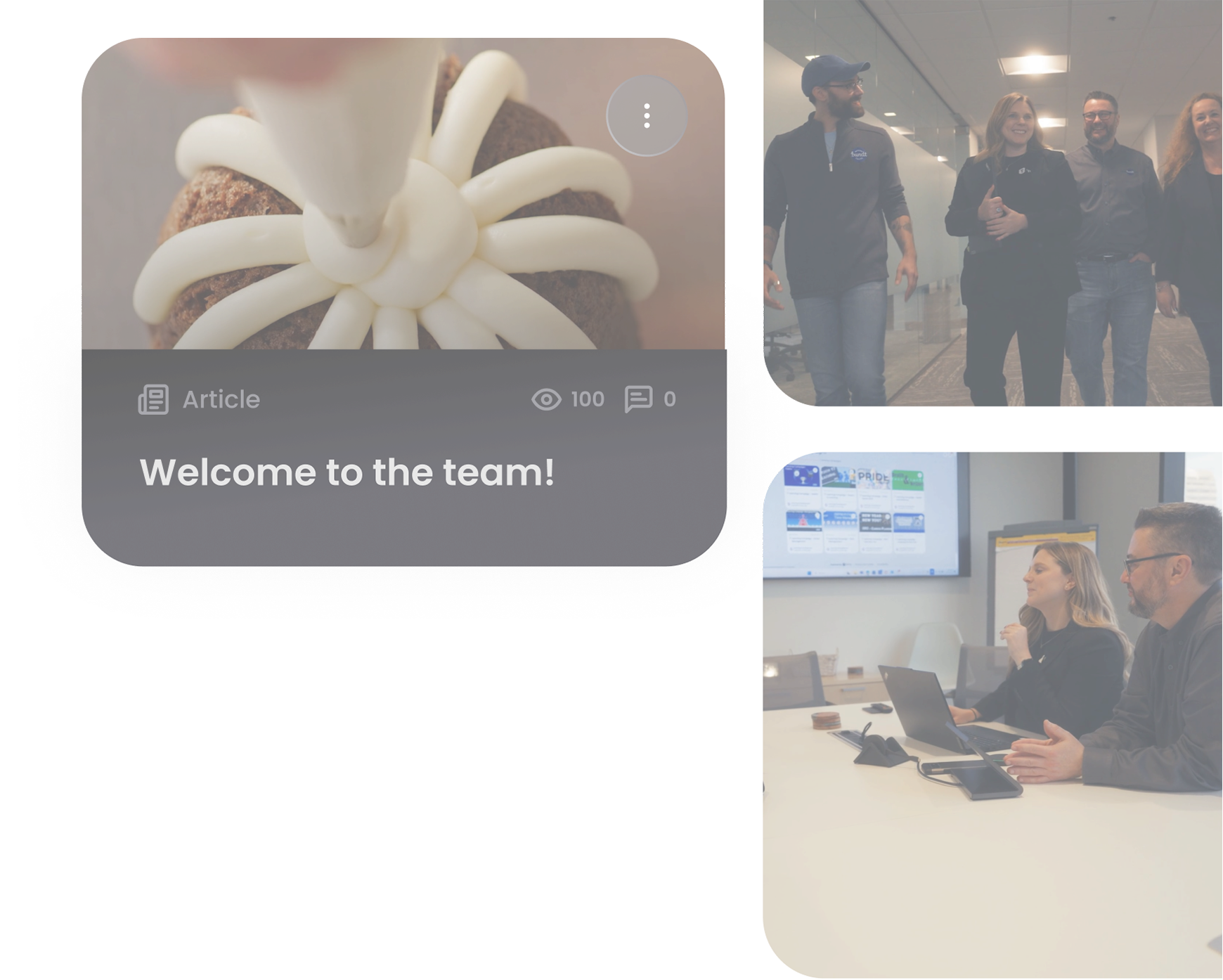
Krispy Kreme is heading in exactly that direction:
“The future of L&D at Krispy Kreme is a world where people aren't just coming to learning and development for everything, but actually collaborating together, sharing their skills peer-to-peer.”
Alex Bailey, L&D Partner, Krispy Kreme
Where to start
Nobody becomes AI-ready through a two-year programme. You build readiness role by role, starting with the ones that matter most right now.
For most L&D leaders, the best starting point is a focused pilot. Pick one role family, define three to five critical AI skills, set baselines with managers and observed assessments, build pathways to close the gaps and track progression over 90 days.
You don't need a perfect framework to start. When Leeds Building Society launched Thrive, 44% of colleagues had started building a skills profile within the first week. That rose to 85% within a month, with 400 goals added.
Five questions to answer before you start:
- Do you have role-level skills definitions, or only generic competency frameworks?
- Is your skills data validated by evidence, or based on confidence ratings?
- Does your learning platform connect to your skills data?
- Can managers see capability data for their teams?
- Do your metrics measure capability change, or just activity?
If the honest answer to most of these is "not really", more content won't fix it. Connecting skills, learning and managers will.
Thrive brings learning, skills, AI coaching and mentoring into one learning platform, used by 500+ organisations across 60+ countries. If you'd like to see how it works, book a demo.
Frequently asked questions
What is skills intelligence?
Skills intelligence is a live, evidence-based view of workforce capability. It maps skills to roles, validates skill levels through manager input and assessments, and connects gaps to development. Unlike a static skills framework, it updates as employees learn and demonstrate new capabilities.
What should skills intelligence software do?
Skills intelligence software, also called a skills intelligence platform, captures, validates and tracks employee skills against role requirements. Thrive's skills intelligence platform lets managers set skill levels, record observed assessments and link skills to goals, CPD and learning content, with levels updating automatically when employees complete skills assessments or tasks.
What is the difference between an LMS and a skills intelligence platform?
A traditional LMS manages learning content and tracks completions. A skills intelligence platform tracks what people can actually do as a result. Thrive combines both, so learning activity, skills data and assessment evidence sit in one system rather than in separate tools.
How does skills intelligence support skills based workforce planning?
Skills based workforce planning means planning hiring, headcount and development around the skills each role needs, rather than job titles alone. Skills intelligence gives that plan live, validated data, so organisations can see which gaps to close through training, mentoring or internal moves before they hire.
What is a skills data platform?
A skills data platform stores structured information about employee skills, levels and development goals across an organisation. It becomes skills intelligence when that data is validated with evidence, kept current and connected directly to learning and development.
How does skills intelligence support AI readiness?
Skills intelligence shows which employees can use AI tools effectively and which need support, based on evidence rather than self-ratings. Research by Zell and Krizan (2014) found self-evaluations are least accurate for complex, unfamiliar tasks, which makes validated skills data especially important for AI capability.
How does Thrive use AI in skills development?
Thrive uses Kiki, its AI agent, to coach employees with AI-generated challenges, reflective prompts and scenario-based exercises. Thrive Mentoring matches mentors and mentees using skills, goals, roles and experience. Thrive's customers include British Airways, Krispy Kreme and Leeds Building Society.

.png)